How deep should a paver patio base be in New Jersey?
150 mm of compacted ¾″ clean stone under foot traffic, inside a 235 mm total excavation — and 300 mm under anything a car drives on. Here is why our freeze–thaw cycle makes that a floor rather than a preference.
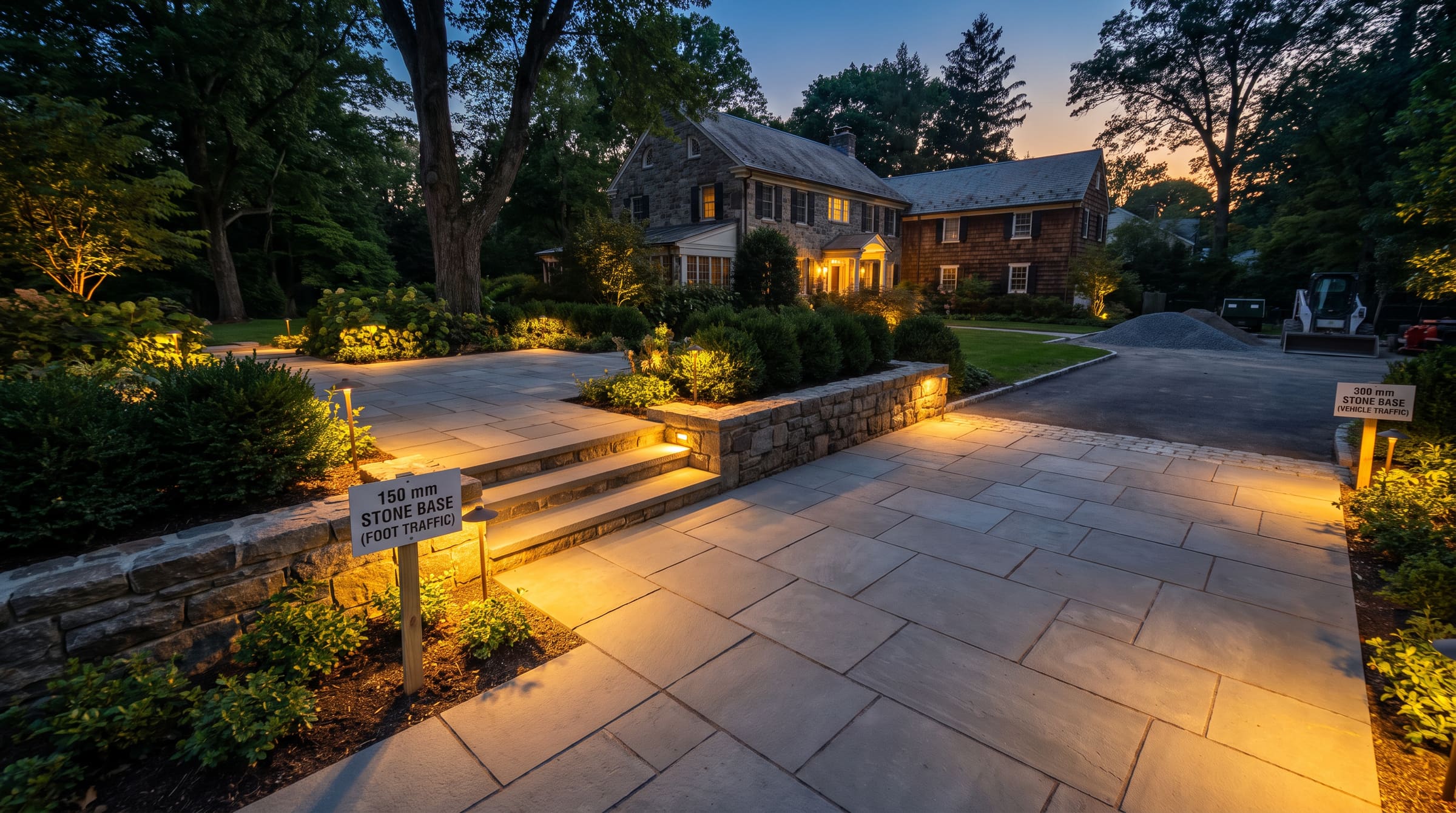
The short answer is 150 mm of compacted ¾″ clean stone under foot traffic, sitting inside a total excavation of about 235 mm once you account for the bedding course and the paver itself. Under a driveway, or anywhere a vehicle will turn, that base goes to 225 mm inside a 300 mm excavation.
The reason is freeze–thaw, and North Jersey has an unusually punishing version of it. We are not cold enough for the ground to freeze once in December and stay frozen until March, which is actually the gentler pattern. We are cold enough to freeze and thaw somewhere between 45 and 60 times in a season, most of those cycles shallow, many of them in the same week.
Every one of those cycles pumps. Water in the base freezes, expands about nine percent, lifts the material above it, then thaws and lets it settle back into a slightly different arrangement. Do that fifty times a year on a properly graded open-graded base and nothing happens, because there is no water held in it and the stone particles have nowhere to migrate. Do it on a base that is too thin, or one built from a material with fines in it, and the base slowly becomes soil.
That is what people are seeing when they say a patio "settled." It did not settle. It got pumped into the subgrade, one winter at a time, and the surface followed it down.
The other half of the answer is compaction. 150 mm of stone dumped in one lift and run over with a plate compactor is not a 150 mm base — the plate only densifies the top 75 mm or so. We place in two 75 mm lifts and compact each one to 95% Proctor before the next goes in, which is the only way the full section actually reaches density.
Questions this raises
- Can I get away with less on a small patio?
- No. The freeze–thaw cycle does not know how big the patio is. A 200 SF terrace on a thin base fails in exactly the same way as a 2,000 SF one, just faster in proportion to how much edge it has.
- What about a "recycled concrete" base?
- Recycled concrete aggregate has fines in it, which means it holds water. It compacts beautifully on the day and it is cheaper. In our climate it is a poor choice under paving, and we do not use it.